
jump to:
How to identify chickens
From their signature combs (the spiky, fleshy, section on top of their head) and wattles (the fleshly flaps at the sides of their head) to their iconic plumage, chickens are a familiar feathered sight on farms and in gardens around the UK.
Whether reared for meat, to produce eggs or kept as pets (most commonly egg laying hens), cockerels (males) and hens (females) are easily identifiable farm animals – but can you tell the difference between the breeds?
Here’s how to identify chickens by their breeds, habitats, routines and behaviours.
did you know?
Despite what you might have heard, chickens can fly – but only in short, low bursts.
Chicken breeds
Light Sussex chicken
Believed to be the first chicken bred in Britain, as far back as Roman times in 43AD, the Light Sussex chicken was originally bred for both egg laying and meat. They’re now a popular breed to be kept as pets.
The Sussex Breed Club formed in honour of Sussex chickens in 1903 and is now one of Britain’s oldest breed clubs.
The Light Sussex comes in eight colours; buff, brown, light, red, silver, speckled, white and coronation.

Rhode Island Red chicken
This domestic chicken originated in America (specifically Rhode Island and Massachusetts) in the 1840s, bred by crossbreeding Malay and Brown Leghorn chickens.
Originally a dual-purpose breed, Rhode Island Reds are now globally renowned for egg laying, producing an average of 260 eggs a year.
They’re large, robust chickens, with red combs and red wattles. Their feathers are usually a shade of red, ranging from crimson to maroon.

Orpington chicken
First bred by William Cook of Orpington in the late nineteenth century, this British breed of chicken was originally bred for both meat and egg laying. They quickly increased in popularity, and are now commonly kept as pets.
Orpingtons are fluffy, round and heavy, with a low stance, and are a variety of colours, from pure white to golden-yellow.

Other chicken breeds
Chicken breeds like Polish, Japanese Bantams, Miss Pepperpot, Plymouth Rock and New Hampshire Red are reared as farmed animals or pets. Though not as common, these breeds have sought-after qualities, such as their dual-purpose nature and suitability for being kept with other pets, like cats and dogs.
Senses
Like many animals, chickens have highly developed senses, helping them navigate the world around them.
Chickens can see more colours than us: Chickens have colour vision and can see red, green and blue light – however, like many other birds, they can also see ultraviolet light (used for rapid-movement detection), which means they see more colours and shade than humans. Their field of vision is around 310 degrees, with their right eye better at seeing up close, and their left eye at seeing further afield.
Chickens can smell ammonia: Chickens can detect lower levels of ammonia than humans, and remove themselves from the hazardous environment. Otherwise, their sense of smell is not as vital as their other senses.
Chickens can hear before they’re born: Chicks learn their mother’s sounds while still in the egg, so that, once hatched, they’re able to recognise her calls and warnings. They can pick up a broad range of sounds from 20Hz (like the low rumble of thunder) up to 40,000Hz (like high-pitched guitar strings).
Chickens have sensitive beaks: Packed full of nerves, their beaks are used for touching, moving objects, feeding, preening, nest building and pecking. Chickens can also feel pressure and temperature with their feet (which is why you may see them lift one leg at a time on a cold day – they’re warming their feet in their feathers).
Chickens are omnivores (they eat plants and animals): Find out more about chicken diets below.
did you know?
Chickens have ears. Hidden on the sides of their head – behind the eyes and the flaps of skin known as a wattle – these are covered by soft feathers that don’t obstruct hearing.

Chicken’s lifespan
Wondering how long chickens live? Chickens in their natural environment, not bred for a purpose but simply as pets, usually live from five to 10 years.
Egg laying hens, however, reach an average of 18 months to two years of age as, once their egg production slows, they’re often slaughtered – although there are some charities who rehome them, like the British Hen Welfare Trust.
Meat chickens, known as broiler chickens, live for slightly over a month. They’re between 35 to 40 days old when they reach optimum weight for slaughter.
Male chicks of egg laying hen breeds are often killed soon after hatching as they can’t lay eggs and don’t produce as much meat as broiler chickens. This remains one of the largest ethical issues in farming to be solved. Find out more about how male chicks are killed here, and find our preferred alternative to male chick culling below.
Chicken
8-15 years

Laying hen
20 months
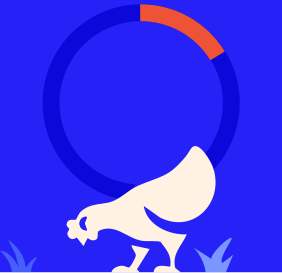
Broiler
40 days
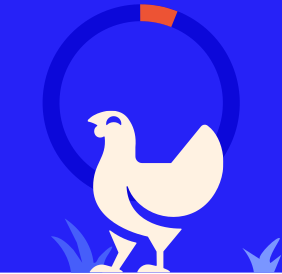
Male chick
1 day

When and where you might see chickens
Chickens are found all across the UK, as farmed animals or kept as pets. Common sites for chicken farms include Lincolnshire, Shropshire, Norfolk and Herefordshire, with garden chickens kept in both residential and rural areas. However, The Wildlife Trust has discovered that the total number of chickens in the UK is still unknown (don’t count your chickens, they say – turns out we can’t).
The habitat of a happy, healthy chicken is one that gives them access to daylight, enriching items (such as straw bales to peck at), perches, nest boxes and room to express their natural behaviours (such as spreading their wings and dustbathing).
Pet chickens live outside in chicken coops; a ventilated, warm and dry chicken house with a litter-covered floor, plenty of space, food and water, places to perch and nest boxes for laying hens to lay eggs. Find out more about keeping chickens as pets here.
Chickens reared for meat and laying hens are kept on chicken farms – find out more about the indoor and outdoor systems used for meat chickens, and the cages, barns and free-range environments of laying hens.
Chickens – specifically cockerels – are known for signalling the sunrise with their signature ‘cock-a-doodle-doo’. Why? Because chickens are very in tune with time. The seasons dictate their routines, such as:

Spring
Egg laying begins:
Laying hens will start the cycle of egg production.
Active mating behaviours:
Roosters actively engage in courting displays and are more protective of their flock.
Summer
Peak egg production:
This is when hens lay the most eggs, often laying every day.
Raising chicks:
Chicks laid in spring will have hatched and are now kept warm by their mothers.
Autumn
Egg laying slows:
As chickens prepare for colder weather, egg production slows, unless they’re selectively bred laying hens kept indoors with artificial lighting.
Moulting:
Old feathers are shed as new ones grow, which will keep them warm through winter.
Winter
Reduced activity:
Chickens sleep more in winter to conserve energy, and are generally less active during the day.
More food required:
Chickens will eat more in colder months to generate body heat.
did you know?
Perching helps hens feel safe – their wild ancestors, the Red Junglefowl also sleep in trees to avoid predators.

Bird flu warning
Due to the Avian Influenza Prevention Zone (AIPZ) currently in place across the UK, don’t touch or handle sick or dead birds. If you have to, thoroughly wash your hands immediately afterwards, keeping them away from your face or food.
Find out more about bird fluChicken behaviour
Over the years, chickens have earned an unfair reputation as unintelligent and fearful. But they’re actually smart, inquisitive birds who can dream and simultaneously keep an eye out for predators.
did you know?
Chickens are direct descendants of dinosaurs! They’re the closest animal to the Tyrannosaurus rex on Earth!
Unlike a T-rex, however, chickens are gentle, domestic omnivores.

Chicken diet
Chickens have a foraging instinct; scratching and searching for seeds, insects and plants keeps them active, mentally engaged and, with the right foods, healthy. Sadly, factory-farmed chickens, also known as lower-welfare farmed chickens, aren’t always able to express these behaviours as the conditions some meat chickens and caged laying hens are kept in don’t provide the opportunity.
As omnivores, chickens have a varied diet. This consists of grains and seeds, insects and worms and, occasionally, small mammals or reptiles like mice and lizards. Farmed chickens are fed a precisely formulated diet, designed to meet their specific nutritional needs, while also promoting efficient production and good health. However, the delivery of their feed may not may not allow them to forage as they naturally would, restricting their instinctive behaviours.
Examples of what
chickens eat naturally:
- Seeds
- Grains
- Fruits
- Nuts
- Herbs
- Plants
- Protein
Examples of what commercial chickens are fed:
- A grain based diet (no
animal proteins or
hormones allowed) - Minerals and vitamins to support the birds' health
- A specifically formulated
diet to meet the birds’ needs and age - Laying hens have yolk enhancers, to make the yolk more yellow
- Veterinary medicines (such as antibiotics, wormers, etc)
The emotional and social lives of chickens
Chickens are intelligent, sociable and communicative creatures – they explore, learn and form complex social structures that keeps their flock (group of chickens) functioning. Here are some fascinating facts about their social and emotional lives:
Chickens have their own language
Chickens communicate with each other, making around 30 different calls to their flock (including purring!).
Chickens can count
They’re intelligent creatures with basic maths skills, able to calculate simple sums and even solve puzzles (so don’t count your chickens – or else they may count you.) Chickens have complex cognitive abilities, great memories and communication skills.
Chickens can recognise faces
As social animals, they can recall people they’ve seen before, recognising up to 100 faces! They also identify other chickens based on their individual features.
Chickens may spar with one another
They sometimes run and flap their wings as a way to establish dominance.
Chickens feel deeply
From extreme happiness (when they close their eyes and purr!), to empathy for other chickens – they’re sensitive animals. This means that when they’re caged or kept in small spaces with limited movement, they also suffer physically and emotionally.
Chickens love to play
Exploring, pecking, jumping, playing with toys and even on swings. When they’re lacking these enriching items, it can have a negative effect on their wellbeing.
Chickens are dictated by a hierarchy
This is known as the ‘pecking order’. These naturally formed social structures help them to know their place, coexist peacefully and prevent conflict.
Clever, emotional, and deeply social, science reveals that chickens are complex individuals with a capacity for logic, empathy, and learning.




Chicken breeding
Unlike other animals, chickens don’t have a specific mating season (though egg laying is higher in spring and summer) – they can reproduce all year round.
First, cockerels will attract the hen by prancing and clucking, and then mount her. Then, the cockerel’s vent area (the opening from which waste is removed and eggs are laid) known as the cloaca, will press up against the female’s cloaca, and the sperm will transfer. This is called the ‘Cloacal kiss’.
Hens store sperm, meaning her eggs will be fertilised for up to three weeks after mating. However, the longer she goes between mating, the lower the fertility of her eggs.
The mother hen will then incubate her eggs (or a brooder will be used, which is an enclosed incubator, heated to replicate the mother’s warmth) until they hatch, which usually happens after 21 days.
did you know?
A group of newly hatched chicks is called a clutch, and as they grow they’re called a brood.

Chicks
Within only hours of hatching, chicks are able to eat, walk and run all on their own (known as being born ‘precocial’), but chicks will stay with their mother for about four to six weeks – though this can vary depending on the breed.
For the first two weeks, the mother hen will provide warmth and protection as her chicks huddle close to her, keeping them safe from other chickens in the flock. She will also teach them how to forage for food.
From three to four weeks, the chicks will begin to forage on their own. They’ll only seek the hen for warmth in colder temperatures.
At five to six weeks, the chicks will have grown most of their feathers and find all their own food. By now, they’ll be weaned from their mum and her protection, gaining independence.
By six weeks of age, the chicks have left the nest and are out on their own and are able to fend for themselves. The mother will now be able to have another clutch of chicks.

did you know?
Chicks can comprehend object permanence by just two days old
Object permanence (the understanding that things still exist even when you can’t see them) can be understood by chicks when they’re only two days old (something human babies can’t do until they’re around seven months old).

How the RSPCA helps chickens
We’ve been campaigning on behalf of farm animals since 1824.
Our campaign to end cramped and cruel cages for farm animals saw 22,000 supporters speak up and take action for caged hens, fighting for their freedom and welfare.
We’re also working to put broiler chicken welfare (chickens bred for meat) back on the menu, urging 18 well-known restaurant chains to prioritise morals over money, and re-commit to the Better Chicken Commitment, which sets out key standards for the welfare of chickens used for food across Europe.
In more recent years, ‘dual-purpose’ breeds are being reared for both egg production and for their meat. Several farms, welfare experts and researchers in the UK are currently trialling the feasibility of dual-purpose breeding systems. We advocate for this method as our ideal alternative to male chick culling: dual-purpose laying hen breeds would ensure the male chicks would be raised for meat rather than culled.
We want all chickens to live better lives.


CHOOSE KINDNESS THIS SUMMER
Every summer, animal cruelty peaks. Right now, it’s at its highest level in five years. But cruelty isn’t the strongest force at work this summer. Love is. Together, we can turn this season of cruelty into one of love, kindness and rescue for animals that need it most.