
You cannot protect the environment while ignoring animal welfare
Author:
Posted:
Why the Government’s Farming Roadmap falls short on real environmental gains
The Government’s eagerly-awaited Farming Roadmap: Growing England’s Future was unveiled this week and with 167 mentions of the ‘environment’ in the report it was clear to see where the focus was.
The 25-year plan was welcomed as a ‘bumper harvest’ and a ‘bold step’ by wildlife and environmental groups who rightly celebrated steps to create ‘cleaner rivers, healthier soils and more sustainable farming’.
And while there is great news for nature, the roadmap fails to build on last year’s animal welfare strategy or acknowledge that you cannot have sustainability or an improved environment without improved animal welfare also being at the heart of the plan. As the One Health approach shows, human, animal, plant and ultimately the planet’s health are interdependent.
'You cannot have an improved environment without improved animal welfare'
Lower welfare farming is the single biggest animal welfare issue we need to tackle. Around 70% of animals farmed in the UK, which amounts to millions of animals every year, are on lower welfare farms (often called factory farms). Many are kept in cages, deprived of comfortable bedding, enrichment and the ability to do the things pigs, chickens and cows naturally want to do. Farming animals on such an unsustainable scale makes it incredibly difficult to protect their welfare and condemns them to a life of suffering. There's little in the plan to address this.
We need a commitment to support farmers to transition to higher welfare farming, and an acknowledgement that we all need to make small changes to our diet, year on year, to gradually reduce the amount of animal products we consume.
It means fewer animals will be farmed and those that are will enjoy higher welfare standards, which our latest research shows means better health , reduced disease risk, less land use and strengthened consumer confidence in British produce here and around the world. This will help build resilience in the face of climate change, food security and geopolitical challenges we are facing.
What were the good parts?
The committment to clearer labelling on how animals are reared - to help shoppers align their desire for high animal welfare with the products on shelves - this was an issue which came out loud and clear in our Citizens Assembly where we asked the public what their priority issues were. But we need clear timetables for change.
Regulation refresh - must include more checks
It was interesting to see mention of better regulation around issues including animal welfare. It’s critically important that we not only have rules in place but they are properly enforced by Government agencies with the statutory powers of entry. There is currently an appalling lack of legal protection for farmed animals in the UK, with the Goverment estimated to be carrying out welfare investigations on just 3% of farms*. Although new technology absolutely should be harnessed to improve enforcement, the Goverment must not scale back in person visits and like the RSPCA Assured welfare-focused assurance scheme, they should carry out more visits, including spot checks.
Chicken welfare is the single biggest farmed animal issue we need to tackle
But the biggest blow was plans to increase poultry production in England but no firm commitment about a move to slower growing breeds of chicken, as in other parts of Europe. Instead the roadmap pledged to support ‘voluntary moves away from fast-growing breeds’.
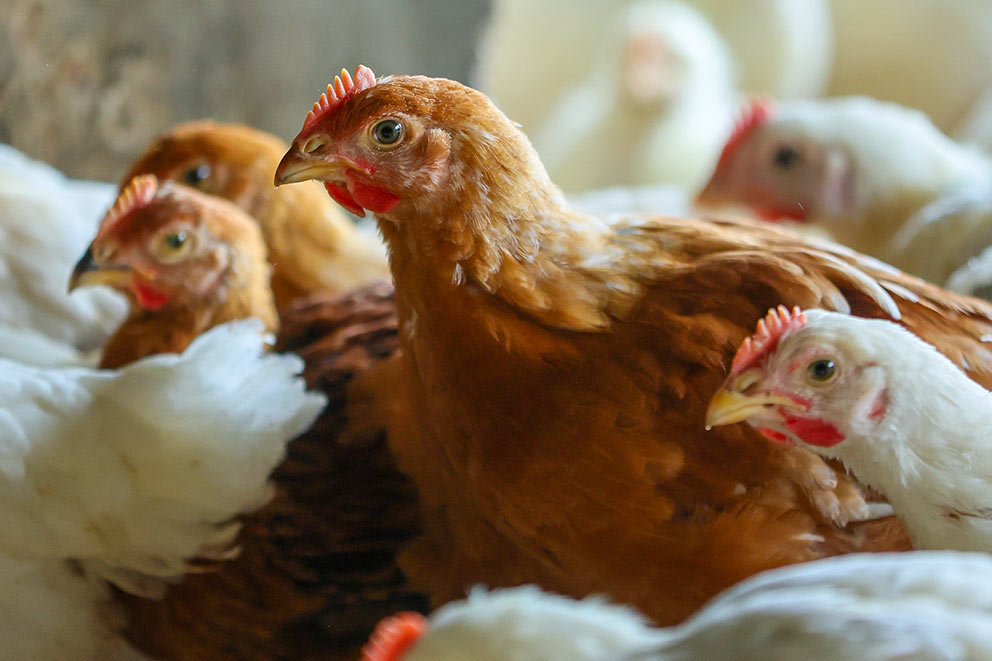
Chicken is the single biggest farmed animal welfare issue we need to tackle. The vast majority of the over one billion meat chickens slaughtered in the UK grow so fast they are now known as ‘Frankenchickens’. These birds can struggle to walk, with many also suffering from other health problems like heart defects, which all contribute to higher levels of mortality.
A 2020 RSPCA-commissioned report - Eat, Sit, Suffer, Repeat - compared the welfare of the most commonly used fast-growing breeds with a commercially viable slower growing breed. The report concluded that these fast growing breeds are born with inherent welfare issues and ‘do not have a life worth living’.
And with chicken consumption rising rapidly we are at a critical crossroad. The Government has the power to improve the lives of millions of birds at a stroke so that shoppers who eat meat can easily choose higher welfare. Or they will set us on the path to ‘profitable production’ in 2050 where we are ‘Growing England’s Future’ at the cost of millions among millions of birds who do not have a life worth living. Not a great future for a self-described nation of animal lovers.
We want to see a future in 2025 where a billion animals have been spared from entering the food chain by small changes to our diets, where those of us eating animal products can make easy, affordable choices and farmers have been financially supported and incentivised to move to higher welfare standards - well above baseline legal standards. That’s a roadmap we will push for - better for the environment, better for farmers, and better for animals.